| The Writing Life (Photo credit: Simply Bike) |
general commentary on psychology and psychotherapy, and other stuff too from time to time
Docsplainin' -- it's what I do
Docsplainin'--it's what I do.
After all, I'm a doc, aren't I?
Pages
Sunday, March 10, 2013
Words to Live By
Labels:
Annie Dillard,
Writing Life
Location: Woodstock, GA
240 Creekstone Ridge, Woodstock, GA 30188, USA
Sunday, March 3, 2013
On Gratitude
| joy! (Photo credit: atomicity) |
I like that one, and I'm going to start prescribing it.
So hop to it. Unhappy? Get out your pen and paper!
Labels:
dog,
Donald Hebb,
gratitude,
Jon Kabat Zinn,
journal,
Mindfulness,
Pockets of Joy,
Pollyanna,
Thich Nhat Hanh,
Tiny Buddha,
Wood's rules
Sunday, February 24, 2013
Bullying
| Physical bullying at school, as depicted in the film Rebecca of Sunnybrook Farm. (Photo credit: Wikipedia) |
One very damaging aspect is the response of the people in charge. Bullying victims get doubly traumatized when teachers, administrators, and parents do nothing: This is experienced as a betrayal, an abandonment, or as further abuse--and sometimes, as all three. For example, a boy who was physically assaulted in front of a raft of teachers who did nothing reported it both the assault and the faculty's inaction to the principal. That worthy's response was that this would not have happened had the student not chosen to come out. In actual point of fact the boy had been outed by one of the bullies some months previously in a separate incident, and he had reported it at the time. So the victim gets the message that nobody cares, nobody's going to do anything, and it's his fault anyway. I suspect that, as studies of childhood sexual abuse have demonstrated, this kind of response on the part of adults is a risk factor for some of the more negative outcomes for the child.
Nor, as far as I can tell, are long-term effects limited to childhood experiences: I know one fellow, retired about four years now, who still has regular nightmares about workplace bullying he suffered. And I have worked with several veterans who count abuse by their superiors as among the worst experiences of their careers.
So am I surprised by the results of this study? Not hardly.
Labels:
abuse,
Anxiety,
Bullying,
Panic disorder
Sunday, February 17, 2013
If Everybody Did
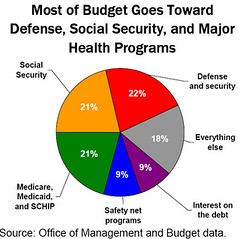
Image by swanksalot via FlickrThe tax complainers seem to see taxes as some kind of terrible, unfair imposition, as if (a) they had nothing to do with electing the governments that assess them, and (b) they never use the services the taxes pay for. They complain about how the money is spent, without much actual awareness of where it really goes. About a fifth, for example, goes for Social Security and Medicare, both of which these folks will apply for the day they become eligible. They elect a government that takes us on military excursions overseas and then resent ponying up their share (almost another fifth of the national budget, not including veterans' benefits) every April. These same people send their kids to public schools and will not hesitate to call the police if their office is burgled, while resenting paying their fair share for these services via sales, property, and other local taxes.
A couple of years ago, the IRS released results of a survey in which about 84% of us said it was never ok to lie on your returns. From that, researchers assumed that about 16% of us cheat. I would bet that there's another few percentage points at least comprised of those who say one thing and do another. Add those together, and you get at least a $345 billion (yes, that's billion) shortfall in any given year. Approximately 3/4 of government borrowing goes to make up this shortfall, adding to the deficit every year. Is it any wonder that early in the wars we saw stories about soldiers' parents having to purchase and ship body armor out of their own pockets? Or that programs and services are being cut or terminated because of lack of funding?
Besides being illogical and selfish, it's unethical to lie on your tax return.
When I was a little girl, someone gave me a book on ethics called If everybody did. The gist of it was that there were some things one person could do once that had small(ish) consequences, but if everybody did it, well, then. . .
Kant for short people
I've been thinking a lot about that little book lately.
What if everybody who ever accepted cash for their work did not report it? What if everybody put their personal dry-cleaning bills, club memberships, and even church pledges down as business expenses? What if everybody claimed everything they bought at the drugstore, from magazines to shaving cream, as medical expenses in order to get the itemized deduction? And before you ask, yes, I've personally known people who've done every one of these things. Where do you think the the money would come from to treat injured veterans? to pay for your Daddy's nursing home? to upgrade the armor on that HUMVEE your cousin's riding around Afghanistan in?
When you cheat on your taxes, you are not cheating the IRS. You are, in effect, cheating your fellow citizens. Your coworkers. Your neighbors. Your children. Your parents.
The irony is that none of these people think of themselves as illogical, selfish, and unethical, or as liars, cheats, or criminals, despite the fact that they are every one of these things.
The whole system is based on self-reporting, on trust. If everybody lied and cheated, it would collapse. If everybody dragged their feet like I've been doing, we'd have to borrow even more every year to keep the government running (10% of the budget every year goes to interest payments as it is). The IRS would have to audit everybody, or maybe they would require all our patients, customers, clients, etc. to start issuing us 1099s at the end of the year. Or maybe we'd just go back to the system of old, when the government just showed up at your front door and took what it needed at the point of a spear. How would you like that?
So you just think about that the next time you are tempted, as a former colleague liked to put it, to "round things off at the corners". I know I'll be thinking about it this spring when the temptation to procrastinate arises.
What if everybody did?
Related articles by Zemanta
- Why we cheat on our taxes (msnbc.msn.com)
Wednesday, June 27, 2012
Doctor, get over thyself
![]() |
| Andreas Kisser - Hubris I & II (Photo credit: Pombinho) |
I am disgusted by the alacrity with which we cry, "But that's bad for psychology!" and spring forth to organize and initiate yet another turf war when the real issue at hand is (or should be) the quality of services to clients. What does it say about our collective character when our first concern is our referral base and not the people--who depend on all mental health providers, not just us? Our greatest concern ought to be for them, but no. Our first instinct is to check our wallets. Our grasping nature probably does far more damage to the profession of psychology than any hard-working, well-trained, underpaid masters'-level practitioner could possibly inflict by--gasp!--performing a psychological assessment.
And while we're on that subject, I find it sublimely ironic that while a masters-level clinician who wishes to test must fill out a two-page questionnaire demonstrating specific proficiency before s/he's allowed to purchase many instruments, any psychologist with a doctorate and a license, no matter how poorly (or not at all) trained s/he may be in psychological assessment, can buy any test in the catalog, no questions asked. Of course it's unethical for one to administer and interpret tests one has never studied and practiced with, but not a few do. It's that hubris thing--too many psychologists think because they have the 'terminal degree' that they're qualified to do pretty much anything they take a fancy to. But that's another rant for another day.

Saturday, May 19, 2012
New Georgia Child Abuse Reporting Law
Some of you who didn't used to be mandated reporters will be now, come July 1. Professionals like me have been required all along to make a report if we suspected abuse, but now just about anybody who comes into regular contact with kids in any organized fashion at any business, agency, or nonprofit is going to be covered. Parents helping out in the classroom, field trip chaperones, volunteers in Sunday Schools, soccer coaches, you name it, it's covered. So it would behoove you all to read the laws on what, exactly constitutes abuse.
While you're at it, pay careful attention to the wording of the law: You have 24 hours to report suspected abuse--which means if you think it might have happened, you have to report. It's not up to whether you believe the child, or think it might have been a one-time thing, or have no proof. It's not your job to investigate it, but the State's. If the child asks you not to tell anybody, too bad. If you've been assured that it won't happen again, or hasn't happened in a long time, too bad.
It's very simple. If you suspect abuse, you must report.
If you don't, you can be charged with a misdemeanor which carries a $1,000 fine and up to a year in jail. Three professionals have been convicted since the current law took effect in 2009. There probably aren't going to be a whole slew of new arrests and prosecutions, but there certainly will be many more reports--which the state is hardly ready to handle. As it is now, many reports go uninvestigated.
While you're at it, pay careful attention to the wording of the law: You have 24 hours to report suspected abuse--which means if you think it might have happened, you have to report. It's not up to whether you believe the child, or think it might have been a one-time thing, or have no proof. It's not your job to investigate it, but the State's. If the child asks you not to tell anybody, too bad. If you've been assured that it won't happen again, or hasn't happened in a long time, too bad.
It's very simple. If you suspect abuse, you must report.
If you don't, you can be charged with a misdemeanor which carries a $1,000 fine and up to a year in jail. Three professionals have been convicted since the current law took effect in 2009. There probably aren't going to be a whole slew of new arrests and prosecutions, but there certainly will be many more reports--which the state is hardly ready to handle. As it is now, many reports go uninvestigated.
Wednesday, August 31, 2011
Going Home; Finding Peace When Pets Die, by Jon Katz (Villard, 2011, 166pp., $22.00 US)
Going Home; Finding Peace When Pets Die, by Jon Katz (Villard, 2011, 166pp., $22.00 US) is a sort of manual for pet owners on pet death and grief, and when it’s necessary, on the decision to euthanize. It’s so much more than that, though—it’s also a paean to our pets and our relationships with them. Indeed, Katz characterizes the grief itself as an expression of our joy in the animal’s life.
Since the book covers both natural and assisted deaths, stressing the need for preparation, it makes useful reading for owners whose pets are still living and healthy as well as for those already grieving either form of loss. Katz includes sections on children’s experiences of pet death, and this is also covered thoroughly in Dr. Debra Katz’s Afterword (which the publisher’s notes refer to as a preface).
Katz works three themes throughout the book. One, we are responsible for making choices that are in the animal’s best interests, not on the basis of what we want or what other people think we should do. Two, grief is normal and natural, and even a good thing, for it cleanses, heals, and stands as testimony to the love we had for our pet. Three, both the decision and the grief go best if we are prepared. What constitutes the animal’s best interests, and how do we tell? How do we grieve? And how do we prepare for deciding and grieving? The book addresses each in depth, including how to involve, prepare, and support the children. Katz approaches each task—which, as he points out, we commit to the moment we bring the animal into our homes and our lives—practically, spiritually, and compassionately. In doing so, Katz is incredibly generous, giving of himself in ways that few would have the courage to do in print. He shares his own grief, his personal failings, and his dreams (in chapters titled “Animal Dreams”).
Three of me read this book and we all loved it. The writer in me admired Katz’s ability to be both succinct and eloquent at the same time. This is the most eminently quotable book I have read in a long time—which is frustrating in a way because the publisher asks that nobody quote it yet as the ARCs are all uncorrected copy. (On which subject, this “uncorrected” copy is in better shape than some books I’ve seen in recent years that are in 2nd and subsequent printings—and still riddled with a ridiculous number of errors. My hat’s off to the editors at Villard.) I have resolved that dilemma by quoting it anyway, as it is just too good to pass up.
The clinical psychologist fell instantly and completely in love with the book. Its message of comfort, its exhortations to responsibility for our animals, its sweet photographs, and its moving stories all made me wish I could order a case of this book to hand out to grieving clients and friends.
And finally, the dotty old woman who still mourns Rosie, who's been dead now for three years, hesitated to even start the book. When it arrived in the mail, I wondered what on earth I had been thinking when I requested it! But I was hooked on the first page. I read it in fits and starts, on lunch breaks and sometimes when I should have been doing paperwork, and I cried every time I picked it up. Sometimes for myself, sometimes for my Rosie, and sometimes for Katz or for whichever animal’s death the current chapter was about. But I found it tremendously comforting and anyway, as Katz put it, “I would hate to have a dog or cat for whom I did not grieve.”
The three of us have only a few, small quibbles with the book. One, and really the only substantive one, is the psychologist’s, and it has to do with the title: I’m uncomfortable with euphemisms like that, seeing them as a denial of the reality of death. The animal is not “going home”. It is dead, not somewhere else—gone. If clients’ personal spiritual beliefs include an afterlife or rebirth, fine. But I am not comfortable leading with that myself, preferring instead to follow the griever’s lead. Another, and I admit that this is so small it borders on petty, is the writer’s. Katz’s otherwise masterful story of The Perfect Day is marred, in my estimation, by the mention of a camera by brand name and model. I had that one myself once, and loved it, but really. That was just kind of jarring. And lastly, the dog owner found herself getting worked up over some of the folk (not Katz) in the book who let their animals run loose, but that’s not a quibble with the book per se. Just be forewarned that’s in there.
Going Home will be available after September 27, 2011, and I highly recommend that if you have an animal, any kind of animal, to which you have become attached, you go out and get yourself a copy. Do it now, not when it gets sick or hurt or old. Buy one for a friend, too, while you are at it.
Subscribe to:
Posts (Atom)