 |
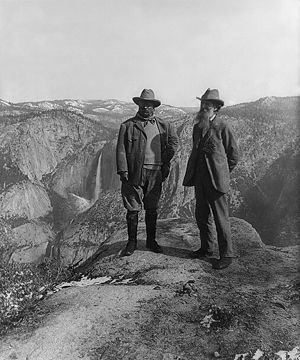
| U.S. President Theodore Roosevelt (left) and nature preservationist John Muir, founder of the Sierra Club, on Glacier Point in Yosemite National Park. In the background: Upper and lower Yosemite Falls. (Photo credit: Wikipedia) |
It's kind of a depressing world we live in. Every day the news is full of bad news--oil spills, murdered children, plane crashes, political chicanery, terrorism, disappearing species. Or we have direct exposure: You see a stray dog hit and killed in the road, or you are haunted by childhood memories of domestic violence or alcoholism. Someone you know is killed in Afghanistan. Or maybe
the thrushes that have nested in your woods every summer since you bought the place back when your kids were little didn't come back this spring. And it is easy to despair.
"I'm just one person! What can I do?
"
This is the question a client asked me the other day. And my answer was, "A lot! You can do a lot!"
Theodore Roosevelt said it best: "Do what you can, with what you have, where you are." People with great resources (money, some sort of public platform from which to reach millions) can do a lot. The rest of us, not so much. But we can always do something, and in relative terms, it counts for much.
The point as I see it is to be a good steward of your little corner of
the world, to leave it just a little bit better than you found it.
Vote. Write a letter to your congressional representative, or your senator. Attend a school-board or city-council meeting. Write a letter to the editor. Demonstrate. Boycott. Raise money for a good cause.
Spay your cat and keep her up. It seems like a small thing, but it does wonders for her health and happiness: Cats allowed to run free are subject to all kinds of bad outcomes, ranging from injuries in fights to infectious diseases to being hit and killed by cars. In her lifetime, you could save as many as 300 birds' lives. That is no small thing! And by not allowing her to reproduce, think how many homeless kitties you've prevented in succeeding generations.
If you can't afford a dog yourself, volunteer at your local shelter. Your efforts will make the animals' lives healthier and happier while they're there, and every hour you donate increases their odds of survival. Adopt (don't buy) one yourself, if you can. You may not be single-handedly solving the homeless dog
population problem yourself, but your action means everything to that one dog. Everything.
Adopt a child. If you can't afford that, get qualified as a foster parent by your local Department of Family and Children Services. Or
become a CASA (Court-Appointed Special Advocate) volunteer. Informally, offer a hand to that overwhelmed parent in the supermarket or in your neighborhood. Or pick up the phone and report a child at risk. You could be saving a life.
I used to carry a hot pink key-chain fob that said, "Woman On a Mission." Quite naturally, people would periodically ask me what the mission was. When I was a child protective services caseworker, I told everybody I was out to change the world, one child at a time. When my practice was predominantly women survivors of domestic abuse, it was "changing the world, one woman at a time." I knew I couldn't change the world, but I believed that my work could be world-changing for the one woman or child in my office, at least for the one hour. You're no different: You, too, can change the world for another living being.
Start a blog. They're free here at Blogger.com and via WordPress. Both will walk you through the set-up process, so you don't even have to be very computer-savvy. Perhaps you know more than you give yourself credit for, and you can share your experience, strength and hope with others. All it will take is a little of your time.
Recycle. Pull your weeds the old-fashioned way instead of poisoning them. Don't use pesticides. You'll help save birds, butterflies, and bees, and our soil and streams will be just that tiny bit much cleaner for your effort. If you have property, plant some milkweed.
Speaking of water, use less. If you can afford it, buy shade-grown organic coffee. If you can't, cut your consumption.
Don't eat chocolate produced by companies that exploit children, use slave labor, or rape the environment. If you can't afford Rain Forest Alliance-certified chocolate, give it up. Or eat less. Buy locally-produced food-stuffs when you can.
Say something nice to somebody today. Do somebody a favor. Or just smile at them. It may not seem like a big thing to you, but it could be the highlight of their day.
My first ethics text, If Everybody Did, by Jo Ann Stover, asks children to consider their actions in the light of this question: What if everybody did that? When you are taking one tiny step toward improving your world even one tiny little bit, ask yourself that. What if everybody did?
What a wonderful world it would be!


